The History of Nail Lamps: From UV Tubes to Dual-Band LED
From 1982 UV tubes to 365nm + 405nm dual-band LEDs — how four generations of light-source technology shaped the modern nail lamp.
The History of Nail Lamps: From UV Tubes to Dual-Band LED
Nail lamps have evolved over some 40 years, from UV fluorescent tubes to dual-band LEDs.
Their development can be traced through four generations of light-source technology.
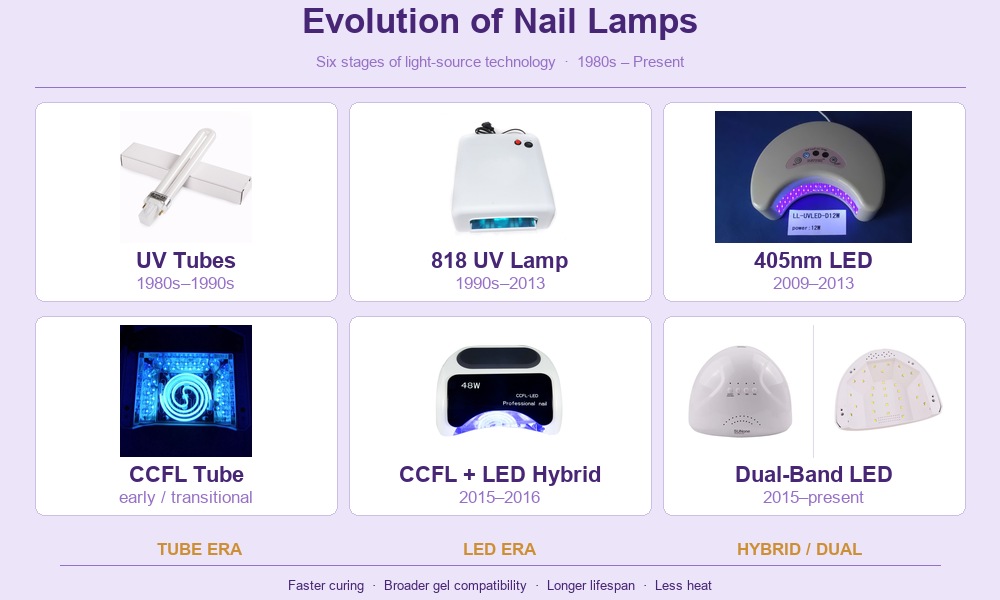
The first generation was the UV tube era, spanning roughly the 1980s to 2013. In 1982,
James Giuliano launched the first UV gel system, "Lamp Light", using a 100W bulb at about
365nm and shaped like an outdoor floodlight. In 1984, OPI invented System III,
which cured with visible light but only one nail at a time. In the early 1990s,
the 9W compact fluorescent lamp (CFL) became the salon standard,
emitting UV above 340nm and lasting about six months.
The 818 series (9W x 4 = 36W) U-tube lamp was a classic model,
with a peak wavelength of 370nm and a 120-second timer.
These lamps offered broad spectrum and worked with most gels, but curing was slow,
tubes were short-lived, they contained mercury and produced noticeable heat.
The second generation was the single-band 405nm LED, from about 2009 to 2013.
In 2008, LED curing technology was introduced to the nail industry. In 2009,
the first UV LED nail lamps were single-band devices emitting only 405nm;
early LED lamps also produced 420nm. In 2011-2012,
Lanke BETTER brand Moon D12W were launched and gained wide adoption.
Curing time dropped from 180 to about 60 seconds, LED life reached 35,000-50,000 hours,
and lamps became compact and energy-efficient. However, single-band 405nm could not cure some UV-type photoinitiators.
The third generation was the CCFL + LED hybrid, around 2015-2016.
Manufacturers launched 36W hybrid lamps with "12 LEDs + 1 CCFL coil",
typically models K6 and D36, with three modes: Mono CCFL / CCFL+LED / No Pain.
CCFL (cold cathode fluorescent lamp) predates LED; it uses a spiral tube, offers a broad spectrum,
low heat and a life of about 50,000 hours.
The idea was to use CCFL's broad spectrum to cover LED's narrow band while keeping LED's fast curing.
But the two light sources cure at different speeds, making timing hard to control,
and CCFL tubes are fragile. It was a transitional compatibility solution, now largely replaced by dual-band LEDs.
The fourth generation is the dual-band 365nm + 405nm LED,
Two LED arrays emit 365nm (activating UV photoinitiators) and 405nm (activating visible-light photoinitiators) simultaneously,
so one lamp covers both gel types. It is compatible with virtually all gels, cures in 30-60 seconds, and offers long life and low heat.